
AI promised lawyers efficiency. For small law firms, it’s not clear whether or not it’s delivering.
Back in March, 8am released its 2026 Legal Industry Report, which surveyed more than 1,300 legal professionals and found a healthy chunk of them saving six to 10 hours a week to AI. Moreover, the share reporting zero productivity benefit from AI collapsed from 16 percent to 6. But plural of anecdote is not data, and the good vibes from the survey didn’t live up to the harsh reality of billing.
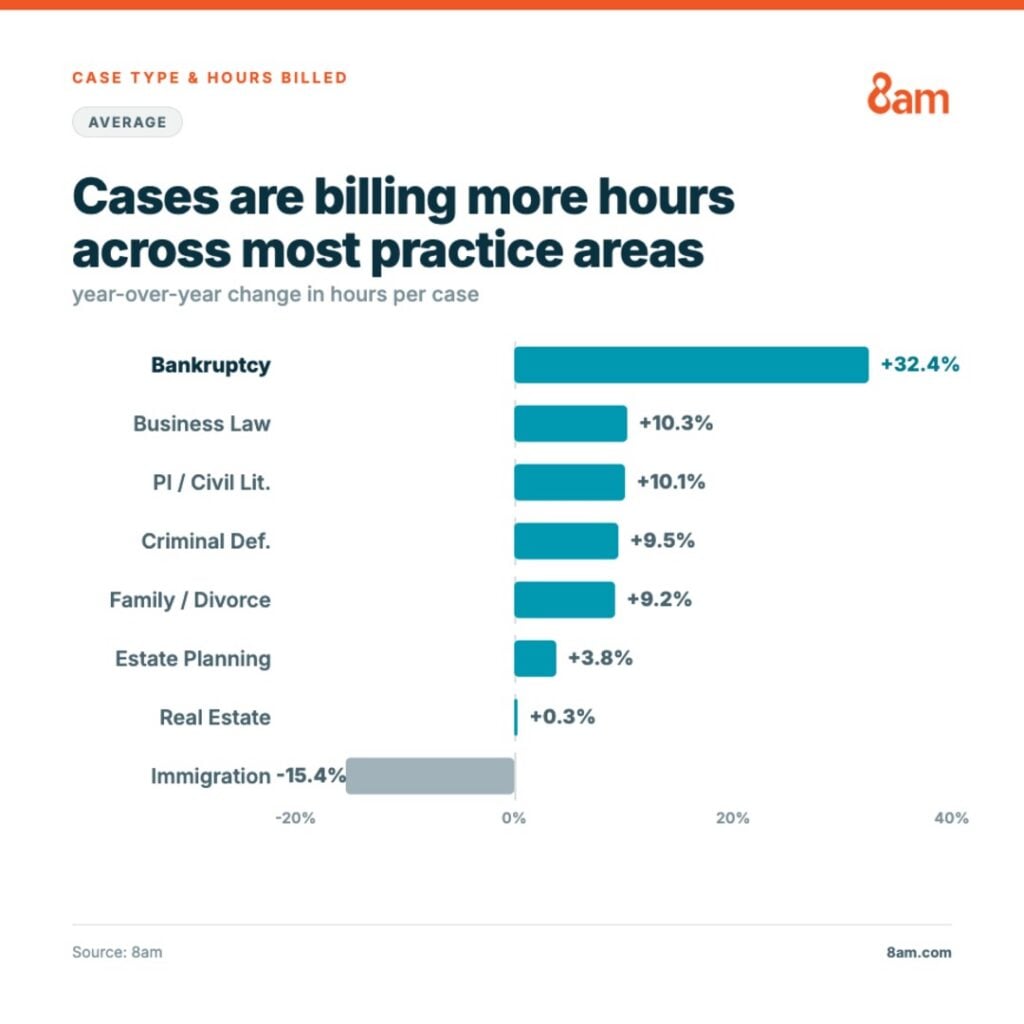
This morning, 8am’s new SMB Law Financial Health Report — drawn from several million bills its MyCase customers issued between April 2024 and March 2026 — found that hours per case went up. It would be one thing to find hours billed going up because lawyers have found more time in the day for productive work, but these are “per case” numbers. There’s no indication that the firms involved have all embraced AI in their practices, but as a trend line, you’d expect the existence of a magic efficiency machine would drag down the average. Or at worst hold constant.
Maybe they’re all working more hours uncovering the hallucinations their adversaries keep filing.
Hours per case went up in nearly every practice area 8am tracks, by three to seven percent in most of them and a startling 32 percent in bankruptcy. The one exception was immigration, because it’s harder to bill when masked government agents have kidnapped your client.
There’s a short menu of explanations. Either AI adoption is much thinner than the survey optimism suggests — which seems unlikely — or it’s not actually producing the efficiency that the survey vibes suggest.
Before anyone credits AI timekeeping tools for quietly padding the entries, 8am checked. Billed dollars per hour rose from $262 to $274 over the same stretch, a 4.4 percent bump that tells you the extra time is real billable work — not lawyers finally logging the .3 they used to eat. And the growth concentrated exactly where the AI-for-solos marketing has been loudest, the four-to-five-attorney firms.
None of which means AI can’t deliver efficiency, but it does suggest it’s not consistently delivering efficiency. We covered a small California firm that used AI to cut a complaint from eight hours to two and a half, dropped its costs 27 percent, and got happier clients out of the bargain. But AI isn’t a push button efficiency multiplier. Lawyers have to put in the time and effort to make AI produce for them.
At least the collections numbers are genuinely good!
Wells Fargo’s Legal Specialty Group reported first-quarter revenue up more than 13 percent, built almost entirely on jacking rates 11 percent — and collections slowing anyway, by six and a half days, with the receivables piling up fastest at the very top of the Am Law 50. Those collection woes haven’t spread to small law (or at least the slice of small law that runs practice management and payment tools through 8am… which seems like a self-selecting group).
According to the 8am report, the share of invoices collected within 30 days climbed from 58 to 63 percent, with the median firm now getting paid the same day it sends the bill. Firms that switched on online payments collect four and a half times faster than the ones still mailing statements. Psychology always suggested that convenience wins. Having a “Pay Now” button or some kind of autopay mechanism proves it. On bills over $5,000, having an autopay plan recovers 79 cents on the dollar against 38 cents with no plan at all.
Biglaw isn’t seeing that collection good news. That said, Fortune 500 general counsel rarely click a “pay now” button. And small law firms aren’t saddled with a ton of work with AI firms and data center construction where the whole industry runs on circular accounting and IOUs. Not to undersell the value of convenient pay mechanisms, but catering to clients who aren’t hyperscalers setting money on fire has to help.
This seems like a grim review of AI. It’s not all bad news. Assuming the industry doesn’t drive off a financial cliff — a medium-sized assumption — the tools will keep improving their capacity to deliver efficiency. But lawyers have to come to grips with the fact that the efficiencies they’re imagining aren’t automatically making it to the bottom line.
 Joe Patrice is a senior editor at Above the Law and co-host of Thinking Like A Lawyer. Feel free to email any tips, questions, or comments. Follow him on Twitter or Bluesky if you’re interested in law, politics, and a healthy dose of college sports news.