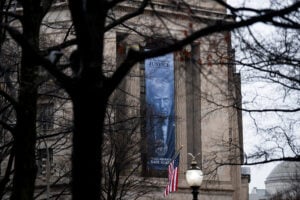
The Department of Justice Honors Program has spent decades selling itself as “the largest and most prestigious federal entry-level attorney hiring program of its kind.” It was the front door to a career in federal law. For a lot of law students, it was the whole plan.
But it is rapidly falling out of fashion.
According to Bloomberg Law, four law school administrators say student interest in the program has cooled, in some cases sharply. Leah Gould, the assistant dean of public interest at Northwestern’s Pritzker School of Law, used to walk about a dozen students a year through their honors and summer-internship applications. The number of interested students, she said, has “dropped significantly.”

From ‘Vendor’ To ‘Partner’: How LexisNexis Is Deepening Law Firm Relationships
The company is emphasizing ‘white glove service’ in the AI era. Here’s what the initiative is delivering for clients.
The reason won’t shock anyone who has watched this DOJ operate.
Students worry that taking a job there now “might be read as an endorsement of the administration.” That, Gould said, is “their biggest concern.”
A few short years ago, the notion the stink of a stint at the Justice Department might trail a young lawyer around for the rest of their career like old fish microwaved in the breakroom would have been laughable. But the students didn’t invent that fear out of nowhere.
The students are just reading the waterline. When the rats start streaming off a ship, you don’t need a maritime license to figure out where it’s headed — and they’ve been streaming off this one since jump. More than 10,000 federal lawyers have abandoned the government since the start of 2025, roughly one in five. DOJ alone has shed 21 percent of its attorneys, more than 2,600 of them, the immigration-litigation shop bled out, the anti-migrant surge kept swallowing whatever was left, and 1,200 former prosecutors eventually wrote the Senate to say it out loud. The president waves off the empty desks as a feature, cheerfully describing the people he kept as chosen for loyalty over competence, which is just an admission that the smart ones left and the loyal ones stayed. Here’s the part that would be funny if it weren’t so grim: the ship is now so short-crewed it will take just about anyone. DOJ suspended its one-year experience requirement so it could grab prosecutors fresh out of law school, begged for AUSAs on social media like it was filling a kickball roster, dangled $25,000 signing bonuses, ran “forward this to a friend” recruiting, and propped Trump’s cronies up as “special attorneys” whenever the real ones wandered off. The department that once sat atop a mountain of eager applicants is now mandating case quotas to the prosecutors it hasn’t lost yet. So when a 3L eyes the gangplank and declines to board, she isn’t being dramatic, she’s just the rat with a working nose.

Why Experience Still Matters In An AI-Driven Legal Industry
A conversation with Trustpoint.One CEO Christopher Gallagher.
Daniela Kraiem, the assistant dean for career and professional development at American University’s Washington College of Law, said watching peers lose offers and slog through shutdown chaos has made the program “a less attractive option.” Which is a tactful way to describe what has happened to the DOJ (dis)honors program over the past 18 months. This is, after all, the same program whose incoming class in early 2025 got their job offers yanked by automated email, the same purge that left roughly 200 rescinded law students and lateral attorneys scrambling for other work. Word gets around a law school fast.
So where are students interested in starting their career (non-Biglaw version)? Gould said she’s watching students steer toward state attorney general offices, “where a lot of the action is anyway.” Matt Nosanchuk, the dean for public interest and public service law at George Washington University Law School and himself a DOJ alum, said state and local AG offices increasingly “align more closely with their particular interests and values.” Angelica Afanador, a rising 3L at American who arrived in 2024 dreaming of fighting for voting rights at Main Justice, is now interning at the ACLU and eyeing nonprofit fellowships. The DOJ plan, she said, “withered away” into something like “the antithesis of what I’d hoped for.”
Listen, the program can keep calling itself the most prestigious entry-level job in American law, and maybe on paper it still is. But prestige is just other people’s opinion of your choices, and a generation of law students has quietly decided this is one they’d rather not spend the next 40 years explaining.
Earlier: Trump’s B.S. ‘Efficiency’ Effort Steals Jobs From Real J.D.s
10,000 Federal Lawyers Are Gone And Trump’s Response Basically Confirms Why They Left
Pam Bondi’s DOJ Lowers Hiring Standards After Driving Away Lawyers With Actual Experience
Once-Elite DOJ Is Now Desperate For Lawyers, Resorts To ‘Forward This To A Friend’ Recruiting
DOJ Rolls Out A Case Quota For The Prosecutors It Hasn’t Lost Yet
Kathryn Rubino is a Senior Editor at Above the Law, host of The Jabot podcast, and co-host of Thinking Like A Lawyer. AtL tipsters are the best, so please connect with her. Feel free to email her with any tips, questions, or comments and follow her on Twitter @Kathryn1 or Bluesky @Kathryn1