Private equity circles the legal profession like a vulture. Even elite law firms are reportedly taking meetings and while none of them appear ready to hand the keys over to private equity yet, the fact that they’re even taking meetings means the idea cleared the first round of speedbumps. People charging $2000/hr don’t waste time discussing some banker’s pitchdeck unless they’re already seriously thinking about it.
Why would a law firm agree to sell off a stake to private equity? The elephant squatting in that room is artificial intelligence, a costly investment in any case, and even more so if it’s the sort of firm interested in building its own bespoke AI model. Private equity can inject a lot of cash for big capital investments, and that industry sees legal as a lucrative business to enter.
The problem for private equity is that we have ethical rules preventing non-lawyers from owning law firms. When entities unbound by the professional rules of lawyers take financial stakes in the success of a law firm, it gives at least the appearance of the firm as a business having obligations beyond those owed to the client and the profession.

From ‘Vendor’ To ‘Partner’: How LexisNexis Is Deepening Law Firm Relationships
The company is emphasizing ‘white glove service’ in the AI era. Here’s what the initiative is delivering for clients.
Undeterred, private equity has a workaround. Instead of buying a direct stake in the firm as is, the business would bifurcate and the lawyers would sit in a wholly lawyer-owned practice of law entity, while all the administrative and back-office work would become a spinoff entity owned by private equity. This “managed services organization” (MSO) would then collect fees for providing all the business of law services to the law firm while taking all those expenses off the law firm’s direct books in exchange for a big payday. It’s how private equity took over dentistry.
And, depending on the terms, it may not be the worst thing in the world! There are efficiencies to be gained in back office operations and lawyers might not be the optimal people to manage that. On the other hand, bifurcating businesses and paying fees to transfer wealth from Peter to Paul is what hastened the destruction of Red Lobster 1.0. All this is to say that I’m not entirely opposed to private equity investment, as long as lawyers approach it cautiously and with a clear eyed understanding of ethical obligations.
But yesterday, I read about another proposed advantage for private equity that made me say, out loud, “oh, hell no” even though absolutely no one else was in the room.
Infodash CEO Ted Theodoropoulos — always a great resource on legal tech and the industry by the way — posted an interesting conversation on his blog with a pair of Holland & Knight attorneys who have become the experts on law firm MSO deals. In his LinkedIn post describing the episode, he included one nugget that threw me:

AI Built for Litigation. Verified by Design.
Grounded in authoritative content and verified at every step, Protégé is the only legal AI tool that delivers work you can trust—without exception.
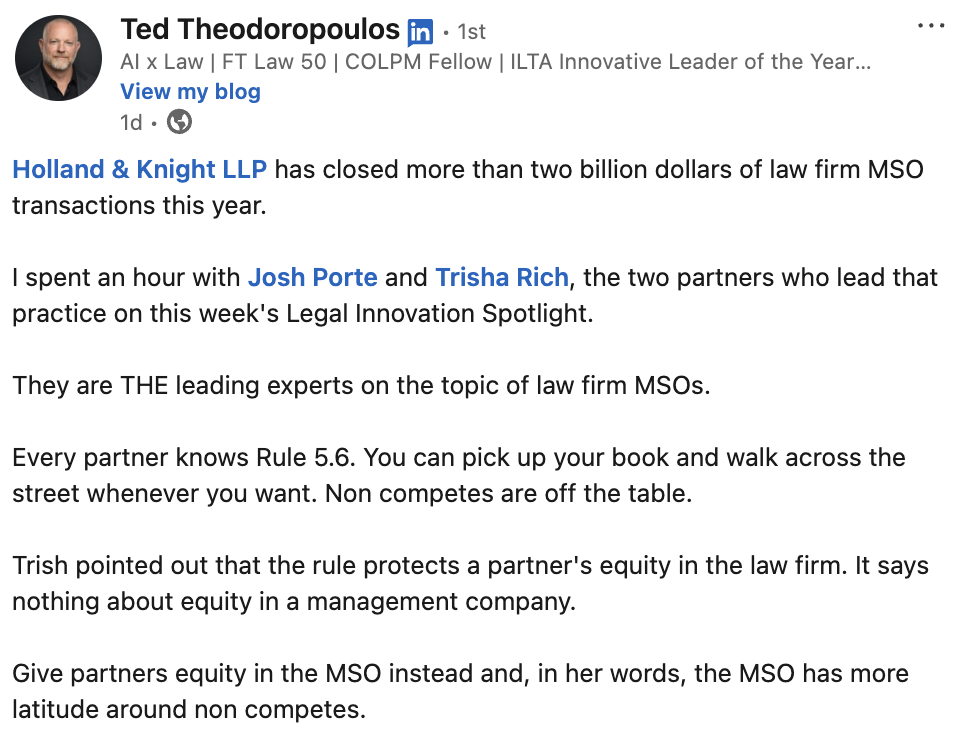
I repeat: oh, hell no.
For clarity, this is the exact quote: “It can help with retention. If an equity partner at a law firm has equity in the law firm, they can leave whenever they want. If they have equity in the MSO, the MSO has more latitude around, for example, non-competes, and tying lawyers up that way.” On the podcast, both lawyers explain that every deal they work on complies with ethical rules and there’s no reason to doubt that. But if you’re inventing whole new business structures to get around the letter of an ethical rule, then you’re very much in breach of the spirit.
This was an off-the-cuff conversation, so maybe there’s more nuance to this. But on the four corners of the podcast — we’ll stick with that analogy — this would seem to be a selling point that at least some firms are getting from private equity, and of all the reasons to go down that road, it’s a troubling one.
Non-competition agreements are a vile employment practice designed to trap workers in undesirable arrangements. For lawyers, the consequences are worse. A lawyer who can’t freely port their client to the most advantageous platform is at least potentially constrained from doing right by their client. Conflicts can block clients from having the lawyer of their choice. It’s just bad news all around.
Rule 5.6 could not be more clear on this:
A lawyer shall not participate in offering or making:
(a) a partnership, shareholders, operating, employment, or other similar type of agreement that restricts the right of a lawyer to practice after termination of the relationship, except an agreement concerning benefits upon retirement; or
(b) an agreement in which a restriction on the lawyer’s right to practice is part of the settlement of a client controversy.
Law firms can already employ shady tactics to steal away books of business by building institutional ties designed to entangle clients even if the original relationship partner departs. But making them sign non-compete agreements, otherwise barred by Rule 5.6, by putting on a different hat takes it to a new level.
And, frankly, if the MSO non-compete functionally prevents a lawyer from enjoying their freedom to move their legal business, it should be a violation of Rule 5.6 anyway. “Restricts” is, one could argue, intentionally broad.
It would be one thing to say — as proponents of MSOs would — that lawyers with stakes in the MSO would be incentivized to stay in ways that pure firm equity couldn’t match. MSOs can use the business side of a firm to open new revenue streams that might be sufficiently attractive to a lawyer to keep them on with a firm they might otherwise not love. There are perfectly fine reasons to adopt an MSO model.
But to raise the spectre of non-competes for lawyers? As a selling point for a firm to gain asymmetrical power over your flow of lateral talent?
That’s worrying no matter what caveats come with it.
Earlier: Private Equity Found A Law Firm That Said Yes
The Richest Law Firms Are Looking At Private Equity Cash Because I Guess They Don’t Have Enough Money
Biglaw Partners Aren’t Ready To Hand Over The Keys To Private Equity Just Yet
 Joe Patrice is a senior editor at Above the Law and co-host of Thinking Like A Lawyer. Feel free to email any tips, questions, or comments. Follow him on Twitter or Bluesky if you’re interested in law, politics, and a healthy dose of college sports news.