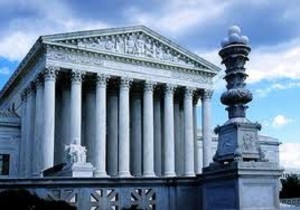
The Supreme Court has spent years careening from one self-inflicted ethics crisis to the next. There was Clarence Thomas quietly pocketing what Fix the Court tallied as roughly $6 million in undisclosed gifts from billionaire Harlan Crow — luxury yachts, private jets, real estate deals, and a relative’s private school tuition, all off the books. There was Ginni Thomas lobbying hard to overturn the 2020 election while her husband declined to recuse himself from cases directly implicated by her activities. There was Sam Alito accepting a private jet from a billionaire hedge fund manager with business before the Court and then declaring in the Wall Street Journal that “no provision in the Constitution gives them the authority to regulate the Supreme Court — period.” There was Alito’s knighthood from a monarchist order — a thing the Framers explicitly prohibited — which he apparently thought was fine. And there was the Court’s eventual response to all of it: a toothless code of conduct with no enforcement mechanism, drafted in such a way as to retroactively excuse the worst of what Thomas had already done, and conflict-checking software that took 827 days to implement.
Now there’s a new potential conflict of interest at the Court’s front door.
Rep. Greg Landsman (D-OH) sent a letter to Chief Justice John Roberts last week raising a question that, once you hear it, is genuinely hard to shake: in a world where anyone with a phone can bet real money on how Supreme Court cases come out, what’s stopping the people who know how those cases come out from doing the same?

AI Built for Litigation. Verified by Design.
Grounded in authoritative content and verified at every step, Protégé is the only legal AI tool that delivers work you can trust—without exception.
The problem per Landsman’s letter, is that while the existing code of conduct *should* cover it but barely, and not explicitly enough to be meaningful.
Prediction markets have exploded. Monthly trading volume on Kalshi and Polymarket ballooned from under $5 billion in September 2025 to roughly $24 billion by April 2026. And the contracts available aren’t exactly abstract. Users were able to bet on the outcomes of cases like birthright citizenship, whether states can count mail-in ballots after Election Day, the president’s ability to fire members of independent agencies, and transgender athlete participation in high school sports. They can also bet on whether and when a specific justice will retire, and who their successor might be.
That’s a menu that would be very interesting to someone who already knows the answers.
Justices know how they’re voting before opinions are released. Law clerks know how cases are coming out. Judicial assistants know when a retirement is imminent. The insider information advantage here isn’t theoretical — it’s structural, and it accrues to a specific, small group of people at One First Street NE.

Filevine’s New Legal AI Platform LOIS Turns AI Into A True Legal Coworker
Legal work isn’t slowing down, and the firms that win won’t be the ones working harder — they’ll be the ones working smarter.
The existing Code of Conduct for Justices does technically cover this: Canon 4(D)(4) states that a justice “should not disclose or use nonpublic information acquired in a judicial capacity for any purpose unrelated to the Justice’s official duties.” The code for law clerks and other judicial employees contains similar language prohibiting the use of confidential information for personal gain. So the argument could be made that this is already prohibited.
But Landsman’s letter makes the case that technically-already-prohibited isn’t enough — partly because the prohibition isn’t explicit, and partly because the conflict-of-interest risk isn’t limited to obviously case-related bets. As the letter puts it, the ban should cover “not only gambling on Court-related outcomes but participation in these markets entirely, as it is not always clear when a wager is based on publicly available information, or nonpublic information acquired through government service.” Someone who knows a justice is about to retire could bet on retirement contracts. Someone who picks up on the internal mood of the Court could have an informational edge on any number of market contracts.
Reform advocacy group Fix the Court had already flagged this issue in May, sending a letter to Judge Robert Dow, the Chief Justice’s Counselor, and the Director of the Administrative Office of U.S. Courts, calling for a branchwide ban covering both SCOTUS and the lower federal courts. That letter dropped the day after the Senate banned its own members and staff from prediction market participation on April 30. The House is currently debating the same.
Which brings us to the delightfully recursive twist buried in Landsman’s letter. There is a case relating to prediction market regulation that may be heading to the Supreme Court. The prospect of justices ruling on the regulation of the very platforms they might theoretically be wagering on, while the public watches live odds update on Kalshi in real time, is the kind of conflict of interest that writes its own punchline.
The letter asks Roberts to “proactively inform the public” that justices and staff are not currently participating in prediction markets, and to commit to an explicit ban going forward. It also cites precedent for the Court issuing such voluntary statements — a 1993 statement on recusal policy, the 2023 ethics principles statement, and individual recusal letters from justices including Gorsuch and Alito — as evidence that Roberts has the mechanism to do this if he wants to.
Whether he wants to is the question. This Court has demonstrated a fairly consistent approach to outside calls for ethics reform: acknowledge them minimally, act on them minimally, and wait for the news cycle to move on. A letter from a Democratic member of the minority, however well-reasoned, is not historically the kind of thing that moves Roberts to act with urgency.
The Court’s ethics problem is not going to resolve itself. If Roberts is looking for a genuinely easy win — a way to get ahead of a problem before it metastasizes into a scandal rather than reacting to one after the fact — this is a fairly painless place to start. All he has to do is say the obvious thing. But um, I wouldn’t hold your breath.
Kathryn Rubino is a Senior Editor at Above the Law, host of The Jabot podcast, and co-host of Thinking Like A Lawyer. AtL tipsters are the best, so please connect with her. Feel free to email her with any tips, questions, or comments and follow her on Twitter @Kathryn1 or Bluesky @Kathryn1