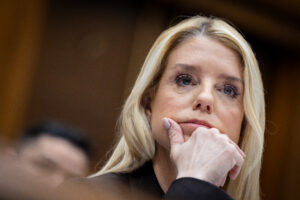
It’s a big week for bar complaints! Hot on the heels of an ethics complaint filed in New York against Acting Attorney General Todd Blanche, over 120 scholars, practitioners, and former judges signed onto a Florida bar complaint against Blanche’s former boss Pam Bondi.
If a complaint against Bondi sounds familiar, that’s because 70-odd lawyers, scholars, and former judges asked the Bar to investigate Pam Bondi’s conduct as Attorney General back in June 2025. At that time, the Bar declined, citing a not-at-all-made-up rule that it “does not investigate or prosecute sitting officers appointed under the U.S. Constitution while they are in office.” The Bar probably thought it had bought itself a reprieve, forgetting that Donald Trump loves firing the women in his cabinet. Now Bondi’s back on the street, and the same group — bolstered by even more signatories — have returned, ominously tapping the “while they are in office” sign.

Managing Partners are Navigating the AI Inflection Point.
New executive research from Ari Kaplan explores how law firm leaders are responding to changing client expectations, evolving economics, talent transformation, and AI governance.
It’s not at all clear what Bondi does these days. The announcement of her shitcanning said that she would “transition to a much needed and important new job in the private sector.” That “transition” didn’t last long, with Todd Blanche calling himself the “Acting Attorney General” almost immediately. Her Florida Bar profile now lists an email address at Ballard Partners, the government affairs shop where she worked before running the Justice Department into the ground. Even if she lingers on in some quasi-official capacity, Blanche’s title bump establishes that Bondi is no longer a sitting officer appointed under the U.S. Constitution.
The lead signatory on the renewed complaint is Peggy Quince, the retired Chief Justice of the Florida Supreme Court. The former Chief Justice of the state’s highest court placing her name at the top of an ethics complaint should grab the attention of disciplinary authorities. Joining her are retired federal judges Nancy Gertner and Michael Luttig — the latter being the conservative legal icon whose involvement should trouble anyone inclined to wave this off as Democratic lawfare.
The complaint is, to use the technical term… a lot. Structured around Bondi’s first-day “zealous advocacy” memorandum, which rebranded the DOJ as Trump’s personal law firm, the complaint places the original sin of Bondi’s tenure in her threatening any government attorney who “deprives the President of the benefit of his lawyers.” While Donald Trump is very much not the client of Department of Justice, Bondi’s proclamation has carried over, with Todd Blanche openly claiming that he believes the president has the “right” to influence criminal probes.
Which, for Blanche, seems to run hand-in-hand with the president’s right to hop into Word and write his own dementia-addled briefs.

Why Experience Still Matters In An AI-Driven Legal Industry
A conversation with Trustpoint.One CEO Christopher Gallagher.
From that root, the complaint identifies four branches. First, the coercion: Erez Reuveni fired for the crime of telling a federal judge the truth, Denise Cheung forced out for refusing to sign a letter she knew lacked probable cause, the Eric Adams prosecutors resigning en masse rather than dismiss a sound indictment as a political favor. Second, the Epstein files debacle. Third, the violated court orders — and there are a staggering number of them. Fourth, the prosecutions brought with no probable cause whatsoever.
It’s important not to lose sight of the fact that, while the complaint recounts three examples of professional coercion directed at lawyers who refused to compromise their ethics for the administration, this is still only a sample:
Ms. Bondi’s actions, directly and through subordinates like Messrs. Blanche, Bove, and Martin, violated Rule 4-8.4(a), which provides that it is misconduct for a lawyer to “violate or attempt to violate the Rules of Professional Conduct, knowingly assist or induce another to do so, or do so through the acts of another. . . .” As described above, Ms. Bondi acted directly, or through her senior managers, to compel their subordinate lawyers to violate their professional obligations. These actions were knowing, moreover, since in every case, one or more lawyers were fired or allowed to resign after they had explained how following these orders would cause them to act unethically. Finally, Ms. Bondi’s actions violate Rule 4-5.1, the ethical rule regarding a lawyer’s ethical responsibility with respect to her managerial duties as Attorney General and her supervision over subordinate lawyers.
Harry Truman kept a sign sitting on his desk that said “the buck stops here.” Bondi does not want that on her desk. In fact, she’s been burned before by what’s sitting on her desk.
Bondi infamously went on TV to tell the public that the Epstein client list was “sitting on my desk right now to review.” One of two things are true: it was either NOT on her desk because it didn’t exist, or it was on her desk and her review ended with “well, there’s no way we can ever let anyone see this!” In either event, her public remarks made promises she didn’t keep. When the actual file releases began, the process was so botched that DOJ published unredacted names, birthdates, and in some cases nude photographs of nearly 100 victims, some possibly underage. Counsel for the survivors called it “the single most egregious violation of victim privacy in one day in United States history.” A nine-page internal review memo devoted exactly two pages to identifying victim information, with no requirement for a multi-level review.
The complaint frames it as a Rule 4-1.1 competence failure and a Rule 4-5.1 supervision failure. Both are true. It is also just grotesque.
The repeated violations of court orders have become so routine they’re getting overlooked. Patrick J. Schiltz, the Chief Judge of the U.S. District Court for Minnesota, compiled a list of 96 orders violated in 74 cases across that judicial district. When the U.S. Attorney called the list “far beyond the pale of accuracy,” the court reviewed it again… and found 113 more violations! Despite the growing attention surrounding the ignored orders, Bondi did nothing, violating Rules 4-5.1 and 4-8.4.
Recounting cases from Jim Comey’s sea shells to the Jerome Powell probe, the complaint flags violations of Rules 4-3.8(a), 4-5.1 and 4-8.4(a) for initiating, inducing, supporting, ratifying, or knowingly permitting Department of Justice prosecutions absent probable cause.
The procedural posture is airtight. Under Rule 3-7.16(d), the Bar may review complaints against former constitutional officers, and may do so for six years after they leave office. Under Rule 3-7.3(a), Bar counsel must investigate any complaint alleging facts that, if proven, would violate the rules, and may only decline if the facts wouldn’t constitute a violation even if true. The escape hatches have been welded shut one by one.
As we’ve noted before, bar discipline is the only accountability mechanism left standing for Trump’s lawyers — criminal liability is foreclosed by Trump v. United States immunity and the inevitable pardons, and civil liability dies on the vine of qualified immunity. The DOJ understands this perfectly well, which is why it’s currently suing the D.C. Bar and floating a new Federal Rule to strip state bars of their authority over government lawyers and, as the case may be, former government lawyers. They are not spending this much effort if they don’t think it might work to force a professional regulator to cower.
The question is whether the Florida Bar believes the rules it purports to uphold apply to one of the most prominent lawyers it has ever held jurisdiction over.
(Check out the complaint on the next page…)
Earlier: Disbar Them All: The Only Accountability Left For Trump’s Lawyers
Todd Blanche Faces New York Bar Complaint After Federal Judge Flags Vindictive Prosecution
 Joe Patrice is a senior editor at Above the Law and co-host of Thinking Like A Lawyer. Feel free to email any tips, questions, or comments. Follow him on Twitter or Bluesky if you’re interested in law, politics, and a healthy dose of college sports news.