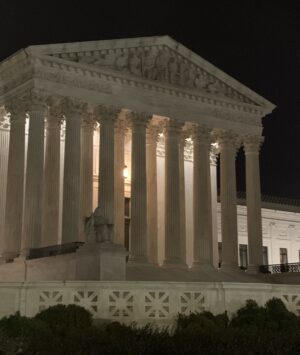
Even amid an ongoing legitimacy crisis, the Supreme Court keeps insisting it doesn’t care about public opinion. That’s probably for the best, because the public isn’t exactly thrilled with the Court right now.
According to a new Gallup poll, the Court’s approval rating has plunged to an all-time low of just 33%, the worst showing since Gallup began asking the question in 2000. An eye-popping 61% of Americans now disapprove of how the job the Court is doing.
It’s hard to say anyone should be shocked. Between ethics controversies, blockbuster rulings that have reshaped American law, and a shadow docket that seems to generate headlines every other week, the justices have become far more visible — and, in the eyes of many Americans, far more political.

AI Is Reshaping Legal Practice—But Tools Aren’t The Real Differentiator.
Explore the mindset, cultural shifts, and training strategies that define the AI‑savvy lawyer, revealing why human judgment, standardized competence, and integrated learning—not technology alone—will shape the future of the profession.
As Gallup notes:
Americans have not been more displeased with the U.S. Supreme Court at any point in at least the last 26 years. This reflects the historically low approval among Democrats and independents combined with mere average approval from Republicans.
Democrats continue to view the Court unfavorably, with approval sitting at just 12%. But the more interesting movement comes from Republicans, whose approval dropped from 79% to 58% after a term in which the conservative supermajority handed the Trump administration several notable defeats, including on tariffs and birthright citizenship.
These findings echo those of a Verasight poll from earlier this month, where nearly half of Republican respondents said the Court needs stronger controls given its perceived entanglement with partisan politics. When even Republicans are questioning how a conservative Court is operating, you know there’s a problem.

What You Didn’t Learn In Law School
How do you keep up with the competition? Share your perspective in this brief survey to help us benchmark your lifelong training in professional skills. As a thank you, qualified respondents receive a chance to win a $250 gift card.
Then again, this didn’t happen in a vacuum. The Court has spent years weathering ethics scandals involving Justices Clarence Thomas and Samuel Alito while Chief Justice John Roberts has struggled to convince the public that the institution stands above politics. Whether it’s decisions expanding presidential power, shadow docket rulings that dominate the news cycle, or Roberts’s inability to get a handle on the Court’s ethics problems, the Supreme Court has given Americans plenty of reasons to question its independence.
The justices have long insisted they’re not supposed to rule by public opinion, and that’s true. But public trust is the judiciary’s only real source of legitimacy. When nearly two-thirds of Americans think the Court isn’t doing its job, that’s not just a bad poll, it’s a warning.
Supreme Court Job Approval Slumps to Record Low [Gallup]

Staci Zaretsky is the managing editor of Above the Law, where she’s worked since 2011. She’d love to hear from you, so please feel free to email her with any tips, questions, comments, or critiques. You can follow her on Bluesky, X/Twitter, and Threads, or connect with her on LinkedIn.