
Law firms enjoy bragging about their good works. Whether it’s a pro bono Supreme Court matter or a mentoring program at a local school, Biglaw strives to let law students know that signing on means more than soul-crushing hours and a fat bonus that will keep them only barely ahead of their loans. But nobility rarely pays the bills, and law students understand that beneath the recruiting pitch, there can be some less savory work in the mix.
And one of Biglaw’s least savory business pipelines involves building pipelines. Or otherwise greasing the wheels of corporate pollution and fossil fuel consumption.
The Law Students for Climate Accountability puts together an annual report ranking the Vault 100 on how much fossil fuel work they do. In the era of on-campus interviewing, the Spring presented an excellent opportunity to do some research before selling your services to a law firm defending the rights of companies to burn chemicals next to schools. Maybe that’s an added advantage to Biglaw blowing up that schedule — they can lock in students before they have time to figure out what their new job entails.

AI Built for Litigation. Verified by Design.
Grounded in authoritative content and verified at every step, Protégé is the only legal AI tool that delivers work you can trust—without exception.
In any event, it’s not all bad news. A handful of firms land at the top of the LSCA list. Like Foley Hoag, a firm that managed to somehow improve upon its three-year run in the A-tier by earning the organization’s first A+ in the seven-year history.
Without further ado, here’s this year’s scorecard:
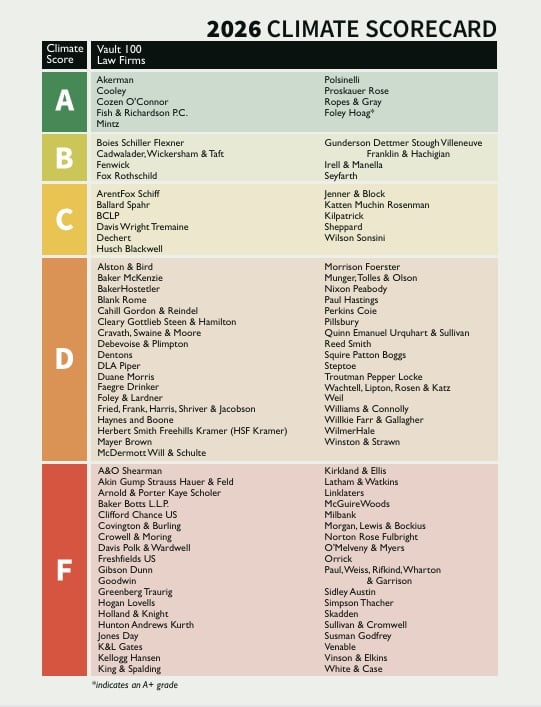
The 2026 Scorecard grades the Vault 100 on litigation, transactions, and lobbying that either exacerbates or mitigates climate change, then assigns each firm the worst of its three scores. LSCA refuses to average, recognizing the concept of “net” damage as uniquely damaging in climate discourse. “The idea of netting is not tethered to reality,” the report explains, “greenhouse gas emissions are not netted out of the atmosphere simply because more renewable energy is being produced.” It’s a methodology designed to frustrate exactly the kind of ESG-page accounting that firms have spent a decade perfecting.

Learning After Law School
Once you’ve got your law degree, how do you keep your professional skills up to date? Share your perspective in this brief survey, and you may be eligible to win a $250 gift card.
Not that law firms tout their ESG work as much these days. Republicans warned Biglaw several years back that vague punishments would follow if firms talk about climate change, and the Trump administration made good on those threats, prompting law firms to scrub ESG mentions from their websites.
And when they aren’t talking about their environmental success — real or imaginary — the work suffers. The topline numbers in this year’s report mark the worst the group has recorded.
The V100 facilitated a combined total of $818,993,000,000 in fossil fuel transactions in 2025; this was also the peak figure over the five-year period, accounting for a disproportionate 26.5% of the total fossil fuel work analyzed. In other words, many of the world’s largest
and most influential law firms are patently expanding emitting fossil fuel industries, in spite of calls to wind down the industry writ large.
The same 10 repeat offenders that have each cleared 12 figures in fossil fuel deal work over five years were responsible for close to half a trillion dollars in 2025 by themselves.
Another key factor in the worsening outlook is the arrival of the AI data center boom. Simpson Thacher ranked first globally in data center transactions in 2024, advising on over $275 billion in deals since 2018. Latham & Watkins, the top M&A firm of 2025, described the year as defined by “AI and data centers.” Sidley Austin advised on a 2,300-megawatt natural gas deal to power Oracle’s AI buildout, with the gas moving through Energy Transfer’s pipeline network — the same Energy Transfer whose Dakota Access SLAPP suits were run by Gibson Dunn. Gibson Dunn, for its part, advised the SpaceX-xAI merger that created xAI’s corporate parent. The firms structuring the AI deals are, unsurprisingly, firms that earned F grades.
The end of that pipeline lands in South Memphis, where xAI installed dozens of methane gas turbines at its Colossus data center without bothering to obtain air permits, in a predominantly Black neighborhood where the cancer risk already runs four times the national average. An xAI representative said the plan for the next facility was to “copy and paste” the approach. The NAACP and the Southern Environmental Law Center have filed notices of intent to sue under the Clean Air Act.
LSCA’s point is that — at this juncture — data center work is fossil fuel work with a facelift. Firms can report reductions in “oil and gas” work while shifting the hours spent setting up an AI campus with unpermitted gas turbines as “technology.”
The litigation findings carry their own familiar names. Only three firms cleared 100 exacerbating-litigation points: Arnold & Porter, Gibson Dunn, and Paul Weiss — the last of which LSCA’s prior coverage flagged as the worst actor in the field. Paul Weiss taking an unpopular action to benefit its bottom line? Surely that can’t be the case!
Across the Atlantic the picture is bleaker still, and the hypocrisy more nakedly documented. Four of the five Magic Circle firms — Linklaters, Clifford Chance, Freshfields, and A&O Shearman — land among the top five UK firms by fossil fuel transaction value, with the five Magic Circle firms together accounting for some $482.5 billion.
Congratulations to those firms earning the As and Bs. They’re outnumbered but prove that there’s still a lucrative business model out there that doesn’t involve scorching the Earth along the way.
(The full report goes into significantly more detail and can be accessed here)
 Joe Patrice is a senior editor at Above the Law and co-host of Thinking Like A Lawyer. Feel free to email any tips, questions, or comments. Follow him on Twitter or Bluesky if you’re interested in law, politics, and a healthy dose of college sports news.