On the one hand, the birthright citizenship ruling allowed Chief Justice Roberts to put a bow on the Supreme Court’s Term, delivering a blow to Donald Trump that Roberts will milk for every “the Supreme Court really is independent!” op-ed that the Washington Post is going give him.[1] The functional end of the Voting Rights Act? Kafkaesque rulings on executive power? Shadow docket Calvinball all the way down? Somehow all of that will get swept under the rug by self-appointed “Court knowers” who will talk about tariffs and birthright citizenship all summer. The Supreme Court took the BOLD STEP of putting the English language over partisan politics! Huzzah.
On the other hand, Roberts’s fellow Republicans didn’t give him the public relations victory he probably wanted. A fractured opinion in the easiest case on the docket didn’t help Captain Balls and Strikes sell his narrative. As a technical matter, the Court decided Trump’s assault on birthright citizenship — a concept so clearly articulated in the Fourteenth Amendment that no one even considered doubting it until this administration — by a 6-3 split, though Kavanaugh only concurred in the judgment, writing separately to draw a road map for Republicans to consummate an end run around the Constitution that would look acceptable through his beer goggles. So it’s more accurate to say the decision split 5-4.
Or maybe it was 6-3 after all. Because buried at the end of the doorstop of an opinion — weighed down by Clarence Thomas writing 91 pages of faux history — Neil Gorsuch dropped 6 paragraphs of dissent that managed to be undeniably a dissent, but also a signal that he would not support Donald Trump doing the one thing this executive order was designed to do.

Beyond Recall And Precision: Strategic Oversight Of AI Managed Review
AI can accelerate document review, but metrics alone aren't enough. Learn how Managing Attorney oversight turns AI-driven review into a more adaptive, strategic and defensible process.
The majority opinion took a look at the Fourteenth Amendment and concluded that, yes, children born here to parents “unlawfully or temporarily present” in the United States are “subject to the jurisdiction thereof” and therefore citizens at birth. Just like they have been for over a century. Conservatives generally took the news with grace and aplomb:
Always encouraging when you reach the “forced sterilization” stage. The folks at the Federalist aren’t alone in being domiciled squarely in white nationalist fantasy land, either. Right-wing social media is crashing out over the decision and “what Roberts did” as though he didn’t just bless the status quo that’s held since Reconstruction. It really is difficult to stress enough that the Constitution did not change here — literally no one thought any of this until recently. And then a handful of fellow traveler scholars recklessly attempted to cobble together a legal theory that never existed before. Randy Barnett wrote a book about the Fourteenth Amendment and decided for the first time in his life that birthright citizenship might not be a thing a year ago, which does not say much for his scholarship.
But the government is staking everything on bombarding the public with the idea that this ruling changed the law, hoping that if they repeat it enough, people will start to believe it.

From ‘Vendor’ To ‘Partner’: How LexisNexis Is Deepening Law Firm Relationships
The company is emphasizing ‘white glove service’ in the AI era. Here’s what the initiative is delivering for clients.
“Now laws.”
In any event, Chief Justice Roberts, writing for himself, Sotomayor, Kagan, Barrett, and Jackson, said yes — walking through the English common law rule of jus soli, the repudiation of Dred Scott, and the 128-year-old holding of Wong Kim Ark that a child born in San Francisco to Chinese subjects was as American as anyone else. The government’s counter-theory — that citizenship secretly turned on “domicile,” a word that appears in the Citizenship Clause exactly never — got the back of Roberts’s hand.
“The trouble is that there is scant evidence for this dramatically revisionist view,” Roberts writes. “Certainly no one said that such
a change had occurred,” he then adds upping the cattiness.
The only evidence the Government and the principal dissent can muster to show that some alternative (“primary”) conception of allegiance displaced the common law is a “funeral oration” for President Lincoln. Ahistorical modifiers aside, the Government and the dissent identify no source that defined allegiance at birth as being based on domicile in the period from 1776 to 1868.
It’s bittersweet to see Roberts snark about “ahistorical” nonsense, since this is the same level of amateurish cherry-picking that forms the basis of so many of his own opinions. You think for a moment that he’s so close to getting it, and then you realize he’s just lobbing an insult because he knows it will get under the skin of the dissenters.
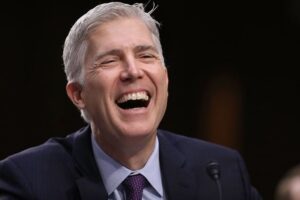
But let’s talk about Neil Gorsuch. Neil Gorsuch did something weird in his dissent that deserves a closer look. And it’s not just that he managed to avoid talking about Native peoples in a case where it would be one hundred percent relevant. He even asked about Indian law at oral argument, thoroughly embarrassing the Solicitor General — who confessed he’d not considered the topic that Neil Gorsuch sees whenever he closes his eyes — in the process. Frankly, it’s shocking that his dissent about the meaning of domicile didn’t take the form of a land acknowledgement.
It’s fair to say a lot of folks didn’t pay attention to Gorsuch’s dissent yesterday, since it was the judicial equivalent of the the 20 minute exposition coda at the end of Lord of the Rings that no one pays attention to. But it’s an intriguing take because it seems as though Gorsuch doesn’t really understand the whole purpose of Trump’s legal assault here.
Standing up for Wong Kim Ark, Gorsuch notes that the parents in that case lived in the United States “even though they never became
naturalized citizens and statutes then in effect made that impossible.”
What matters isn’t whether a child’s parents are citizens. What matters is whether they (and, by law, their child at birth) have made this place their home and are thus “domiciled within the United States.”
And when it comes to domicile, Gorsuch mused that this… probably does cover undocumented migrants.
Besides addressing temporary visitors, the order also denies the benefits of citizenship to children born in this country to parents who make their permanent home here, but do so in defiance of federal immigration laws. The government insists that aspect of the order can survive any possible legal challenge, too, because individuals can secure domicile in this country only if they do so in compliance with federal law.
….
Still, I wonder: Is a child born here to parents who have long chosen to make this Nation their permanent home not a citizen under the Fourteenth Amendment solely because his parents’ presence violates statutory law? If those parents are not domiciled here, then where are they domiciled? And if the answer is nowhere, how can we reconcile that conclusion with this Court’s longstanding recognition that every person is domiciled somewhere?
But, see, Executive Order 14160 was never really about someone accidentally giving birth in a hotel. The whole point of this Stephen Miller fever dream of a memo was to strip citizenship from the children of undocumented immigrants. Neil Gorsuch dissented and then gratuitously announced that he wouldn’t back the only thing the Trump administration actually cares about.
Neil Gorsuch is a chaos agent. In the Federalist Society drive to guarantee “No More Souters,” they managed to find an even more curious animal. An ideologue so confident in his own abstractions that he’ll occasionally lean against a door frame and knock down the whole Potemkin village.
UPDATE: Because the Supreme Court still refuses — for very dumb reasons — to put themselves on camera, On the Docket is using AI to visualize clips from oral argument. Here’s Gorsuch running Solicitor General Sauer on domicile:
[1] Note that I said “op-ed,” because the editorial board over at the Bezos Post already came out to complain that the Supreme Court gets too hung up on the whole “following the Constitution” thing.

Joe Patrice is a senior editor at Above the Law and co-host of Thinking Like A Lawyer. Feel free to email any tips, questions, or comments. Follow him on Twitter or Bluesky if you’re interested in law, politics, and a healthy dose of college sports news.